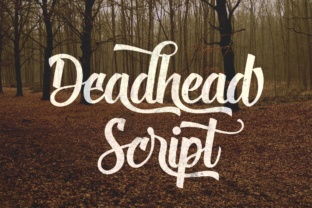
Deadhead Script: A Playful Brush Lettering Font for Handmade Creators
It started with a candle label—just a simple soy wax blend named “Honey & Sage.” I opened my design file, scrolled past the usual go-to fonts, and paused when Deadhead Script loaded. That first lowercase h, with its springy entry stroke and soft exit flick, felt like watching ink bloom on handmade paper. This isn’t just another Script Handwritten font—it’s a living, breathing brush lettering rhythm built for real craft work.
Deadhead Script for Candle Labels and Small-Batch Product Packaging
When you’re hand-pouring candles or bottling herbal tonics, your label is often the first tactile impression a customer holds. Deadhead Script adds instant warmth and intention—no stock photo vibes, no sterile sans serif stiffness. I tested it at 14pt on matte kraft sticker paper, and the subtle contrast between thick downstrokes and airy upstrokes held beautifully. Because Deadhead Script is designed as a display Fonts family—not meant for body text—it shines brightest on short phrases: scent names, batch numbers, or “hand-poured in Portland.” For readability on tiny jar labels, I paired it with a clean, low-contrast sans serif (like Montserrat Light) for ingredients and warnings. Always check the included OpenType features—ligatures and contextual alternates help avoid awkward letter collisions on curved surfaces like candle tins.
Deadhead Script for Wedding Invitations and Elegant Branding
There’s something quietly powerful about seeing Deadhead Script wrap around a couple’s names on a digital wedding invitation preview. Its playful energy never tips into childishness—thanks to deliberate spacing, balanced x-height, and graceful swashes that feel intentional, not automatic. As a Script Handwritten typeface inspired by real brushwork, it brings organic texture without sacrificing polish. I used the uppercase swash ‘A’ and ‘W’ for the couple’s monogram on a foil-stamped belly band, then dropped back to standard capitals for RSVP details. For physical printing, I confirmed the font includes full Latin character support and basic punctuation—critical when names include accents or ampersands. Since many invitation suites extend to menus, place cards, and signage, Deadhead Script holds consistent personality across formats while letting supporting fonts (a delicate serif like Playfair Display) handle longer passages.
Deadhead Script for Printable Wall Art and Digital Downloads
If you create printable wall art for Etsy or Creative Market, typography *is* your product. Deadhead Script gives quotes, affirmations, and seasonal phrases (think “Gather Joy” or “This Space Is Sacred”) an inviting, human-made charm that photographs well and prints cleanly—even on textured watercolor paper. As a Fonts asset, it performs reliably in Canva, Adobe Illustrator, and Procreate (via OTF installation). I tested it at 72pt for an 8x10” digital download: the curves stayed smooth, no pixelation, and the weight distribution kept the phrase feeling grounded, not floaty. Because Deadhead Script is a single-weight display Script Handwritten font, I avoided using it for multi-line poems—but found magic pairing it with a thin, airy sans serif for subtitles or attribution lines.
Deadhead Script for Boutique Tags and Handmade Shop Branding
That little kraft tag tied to a ceramic mug or linen pouch? It’s where Deadhead Script earns its keep. Its expressive flow makes even “Made with Love” feel personal and considered—not templated. I printed tags at 10pt using a laser printer, and the fine hairlines remained crisp (no smudging or breakage). For Cricut and Silhouette users: test cut files first—the font’s natural stroke variation means some swashes may need slight simplification for intricate vinyl weeding. Always review the included file formats: TTF and OTF are standard, but if you’re creating SVG bundles for crafters, confirm commercial licensing covers derivative designs. Deadhead Script doesn’t pretend to be neutral—it leans into its playful, detailed personality, making it ideal for brands that value authenticity over uniformity.
Deadhead Script for Planner Pages and Handwritten-Style Digital Planners
In Notion, GoodNotes, or PDF-based planners, Deadhead Script transforms functional layouts into joyful experiences. I added it as a header font for monthly habit trackers (“June Goals,” “Weekly Intentions”)—its bounce adds lightness without distracting from checkboxes or calendars. Because it’s a Script Handwritten typeface built with high attention to detail, letterforms stay legible even when scaled down to 16pt in narrow column headers. For best results in digital planners, embed the font in your PDF or use it as a non-editable graphic layer—avoid relying on system fallbacks. Pair it with a friendly, rounded sans serif (like Quicksand) for instructions or notes to maintain visual harmony without competing energy.
Deadhead Script for Seasonal Stickers and Holiday Craft Supplies
Sticker sheets live or die by readability and charm—and Deadhead Script delivers both. On 1-inch round stickers (“Cozy Vibes,” “Merry & Bright”), its open counters and generous spacing prevented ink bleed during kiss-cutting. As a Fonts choice for holiday crafts, it balances festivity and sophistication: no cartoonish loops, no stiff formality—just joyful movement you can almost hear. I tested it across three substrates: glossy vinyl (crisp), matte paper (softened edges), and clear static cling (surprisingly vibrant). For seasonal listings, using Deadhead Script in mockups—on mugs, tote bags, or wooden signs—immediately signals handmade care. Just remember: always verify commercial license terms before bundling into sticker templates or SVG packs sold to other makers.
How to Use Deadhead Script With Confidence
- Best for short, impactful text: names, titles, slogans, labels, and decorative phrases
- Avoid for long paragraphs, small print (under 10pt), or dense packaging copy
- Always pair with a contrasting, highly legible font for balance
- Test cuts, prints, and screen renders before final production
- Review included ligatures, swashes, and language support before launching branded products